
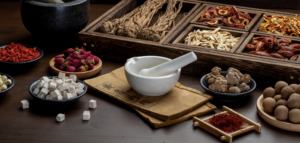
Complementary and Alternative Medicine (CAM):
Chinese Herbal Medicine
TCM focuses on balancing the body’s energy, or “Qi” (pronounced “chee”), which is believed to flow along channels in the body called meridians. Any imbalance or blockage of the flow of Qi is believed to lead to illness.
- See:
- Traditional Chinese Medicine (TCM)
- TCM – Chinese Herbal Medicine (introduction)
- TCM – Acupuncture (introduction)
- Acupuncture – Migraine Headaches
- Acupuncture – Trigger Point & Myofascial Pain
- Acupuncture – Osteoarthritis
- Acupuncture – Peripheral Neuropathy (Overview)
- Acupuncture – Diabetic Peripheral Neuropathy (DPN)
- Acupuncture – Chemotherapy-Induced Peripheral Neuropathy (CIPN)
- Acupuncture – Sciatica
- Acupuncture – Fibromyalgia
- Acupuncture – Mechanisms of Actions
- Acupuncture – Transition from Acute to Chronic Pain
Traditional Chinese Medicine
Key Concepts in TCM:
- Qi (Vital Energy): TCM theory holds that Qi is a life or vital energy that constantly changes and runs throughout the body, influencing spiritual, emotional, mental, and physical health.
- Meridians: Qi flows freely through channels called meridians, each corresponding to a specific part of the body that controls a particular function.
- Yin and Yang: Health is seen as the balance of two opposing forces, yin (negative, dark, passive) and yang (positive, light, active). TCM aims to restore this balance.
- Five Elements (Wu Xing): This theory provides a framework for understanding the relationships between the mind, body, and environment, and is used for diagnosis and treatment.
Common TCM Practices:
- Acupuncture: The insertion of thin needles into specific points along the meridians to stimulate the flow of Qi and alleviate pain and other conditions.
- Chinese Herbal Medicine: The use of tailored herbal formulas to treat a variety of ailments and support the healing process.
- Tui Na (Chinese Therapeutic Massage): A form of deep-tissue massage and manipulation to release Qi blockages and promote circulation.
- Cupping: Heated cups are applied to the skin to create suction and stimulate the flow of Qi.
- Moxibustion: The burning of dried herbs near the skin to stimulate certain points.
- Tai Chi and Qi Gong: Mind-body exercises that combine specific movements, breathing, and mental focus to improve health and longevity.
- Dietary Therapy: Using food and diet to restore yin-yang balance.
Evidence and Safety:
- Acupuncture is generally considered safe when performed by a certified practitioner. Studies have shown it to be effective for pain relief, managing chemotherapy side effects, and improving quality of life. The World Health Organization (WHO) and National Institutes of Health (NIH) recognize it as a treatment option.
- Chinese herbal medicine can be effective but may also cause side effects or interact with other medications. It is important to consult with a qualified TCM practitioner and inform your doctor about any herbal remedies you are using.
- Further research is needed to fully understand the mechanisms of TCM and its effectiveness for various conditions.
- Using acupuncture to manage pain and nausea alongside chemotherapy in cancer care.
- Incorporating TCM practices like tai chi and meditation for stress and mental health support.
- Using acupuncture and herbal medicine in fertility treatments.
Combining Acupuncture and Chinese Herbal Medicine
Combining acupuncture and Chinese herbal medicine is a core principle of Traditional Chinese Medicine (TCM). These two therapies are designed to complement each other—one works primarily through stimulation of specific points on the body, and the other works internally through carefully formulated herbal prescriptions.
Here are the key advantages of combining them:
1. Stronger Therapeutic Effect
- Acupuncture helps regulate the flow of Qi and blood, quickly relieving symptoms such as pain or tension.
- Herbal medicine works systemically, addressing underlying imbalances over time.
- Together, they often produce faster and more sustained results than either alone.
2. Treats Both Root and Symptoms
In TCM, treatment focuses on:
- Ben (root) – the underlying imbalance
- Biao (branch) – the symptoms
- Acupuncture may relieve immediate discomfort (e.g., migraines or back pain), while herbs correct the deeper constitutional issue.
3. Faster Symptom Relief
Acupuncture can provide rapid relief for:
- Pain
- Stress
- Insomnia
- Digestive discomfort
Herbs then continue supporting healing between sessions.
4. Enhanced Regulation of the Whole Body
- Acupuncture stimulates the nervous system and improves circulation.
- Herbs nourish organs, build blood, clear heat, expel dampness, or tonify deficiencies.
Together they support:
- Hormonal balance
- Immune function
- Digestive strength
- Emotional regulation
5. Reduced Need for Stronger Interventions
When combined early, the two therapies may:
- Prevent chronic progression
- Reduce reliance on stronger medications
- Improve recovery time
6. Better Results for Chronic Conditions
The combination is commonly used for:
- Chronic pain
- Fertility support
- Menstrual disorders
- Digestive disorders
- Anxiety and stress-related conditions
For example, in fertility care, acupuncture improves pelvic blood flow, while herbal formulas regulate cycles and strengthen reproductive function.
7. Personalized Treatment
Both acupuncture point selection and herbal formulas are tailored to the individual’s specific pattern diagnosis, making the combination highly customized.
References:
Emphasis on Education
Accurate Clinic promotes patient education as the foundation of it’s medical care. In Dr. Ehlenberger’s integrative approach to patient care, including conventional and complementary and alternative medical (CAM) treatments, he may encourage or provide advice about the use of supplements. However, the specifics of choice of supplement, dosing and duration of treatment should be individualized through discussion with Dr. Ehlenberger. The following information and reference articles are presented to provide the reader with some of the latest research to facilitate evidence-based, informed decisions regarding the use of conventional as well as CAM treatments.
For medical-legal reasons, access to these links is limited to patients enrolled in an Accurate Clinic medical program.
Should you wish more information regarding any of the subjects listed – or not listed – here, please contact Dr. Ehlenberger. He has literally thousands of published articles to share on hundreds of topics associated with pain management, weight loss, nutrition, addiction recovery and emergency medicine. It would take years for you to read them, as it did him.
For more information, please contact Accurate Clinic.
.